CreativeX, the system of control for creative, content, and media, has recently launched Datalink, housing creative data with attention, emotion, and other types of data in one place.
In other words, it is a connective infrastructure for brands to integrate multiple sources of creative intelligence into a single dashboard. This enables brands to layer and activate insights seamlessly across their existing media and production workflows. Early Datalink partners include Amplified, Kantar Link AI, Adverteyes, Dragonfly AI, and DAIVID.
"For years, creative data has lived in silos, attention metrics in one place, performance data in another, brand compliance somewhere else. Datalink changes that by bringing these signals together within the workflows brands are already using. That's what makes it powerful, it doesn't ask teams to change how they operate, it gives them a significantly richer picture of creative effectiveness right where they're already making decisions." – Carl Carter, SVP Strategic Partnerships, Dragonfly AI
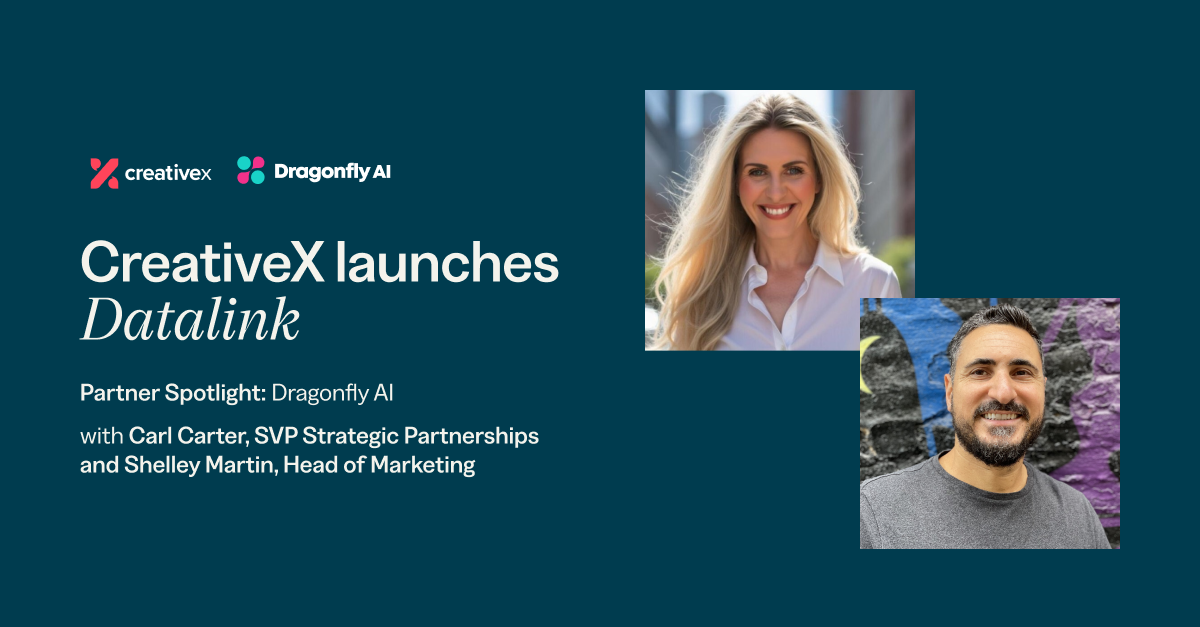
Dragonfly’s Carl Carter, SVP Strategic Partnerships and Shelley Martin, Head of Marketing, share more on their technology, the information gap in creative analytics, and how brands can take advantage of the integration between Dragonfly AI and CreativeX.
"The evidence is clear — up to 70% of media effectiveness is driven by the creative itself, yet most brands have very limited insight into why one piece of creative outperforms another. Traditional approaches like eye-tracking studies are robust, but they're expensive, they take weeks, and they simply can't keep pace with the volume of content global brands are producing today. Dragonfly AI was built to close that gap," explains Carl.
"The questions brands are asking haven't changed, what are consumers actually looking at? What's holding their attention? What's driving action? — but the speed and scale at which they need those answers has transformed completely. Brands need creative intelligence in minutes, not weeks, and they need it applied consistently across every channel and market. That's the shift we're enabling, and it's why partnerships like this one with CreativeX matter, they put actionable creative insight directly into the operating model where it can genuinely drive performance."
“How can I really understand how people interact with content? How can I understand what it is that they are engaging with? What’s engaging about it?, but achieved in a very agile manner, within minutes, and be able to scale that at an enterprise level - that’s what global brands really need” he continues.
What is Dragonfly AI and how did it come to be?
Dragonfly AI partnered with Queen Mary University of London to create a neuroscience-backed algorithm validated by MIT that is designed to replicate how the human brain perceives and responds to visual stimuli. Contrast, depth, texture, is all translated into the Dragonfly AI platform, providing insights around attention, memory, and emotion to give their customers, “better insight about what’s going to perform before they even put it into the market, but also, importantly, allows them to quickly adapt and change content in the market when they need to.”
“Dragonfly AI is an omni-channel solution, it gives us a universal scope. We’re looking at things like color, contrast, rhyme, rhythm, all these things that invoke at a very human universal level. Irrespective of whether it’s social or out of home or a hero image on the website, we have a good understanding of it. And global brands need that information in order to deliver really great campaigns.”
Martin chimes in here, “My background is in science and I’ve worked in marketing for over 15 years, I’ve always been working on the insights, data, and strategy that informs marketing campaigns. I joined Dragonfly AI because I was excited by the technology, real data insights that inform and improve the creative, while leading with human insight. I was drawn to the technology and the ability to actually test creative very quickly and at scale, that felt quite exciting for me.”
Carter agrees, adding his own experience, “I’ve spent the last 15 years in software with e-commerce and global brands, and also in the world of behavioral analytics. And I found that the big gap was in the content itself. You can build great UX, you can deliver to all channels, on mobile devices, and have lots of different formats from video to images. But actually, the big, gaping hole that we needed to try to understand was, is it actually driving action from customers? And a big part of that comes down to the creative.”
“Customers would speak to me and say, ‘well great, I understand where they’re clicking to and from, but how can I understand if they’re actually looking at that piece of content?’ And that’s what really drew me to Dragonfly AI, with the frequency of content, the scale of it, personalization, the massive driver in all of this is how we can better understand if and how people interact with any content in order to optimize it for that person, at that time, and at that place. And you just can’t do that from traditional methods, you have to have a different solution for that. And that’s what the Dragonfly AI platform can help with, and we’ve been able to prove the commercial impact of that work, by combining lots of different data points to understand what is actually within that content that drives performance for that brand specifically.”
What are common challenges and opportunities for brands?
- Overcomplicated creative overwhelms the audience
“A lot of the content that’s being developed can be overcomplicated, they’re trying to fit too much in there,” Carter shares, “from an attention standpoint, you’ve got three seconds to grab attention in these channels, that’s not a lot of time. So how can I digest the content in a very succinct manner that leads to an action? Dragonfly AI’s platform has a digestibility score that effectively allows you to see what they’re looking at in what order within the system, and whether that really aligns to your business goals. And we often see that the audience can only digest about four things at any given time, but brands are putting eight, nine things in there. So the audience ends up overwhelmed. We see a big trend to keep it simple, keep it balanced in order to garner attention.”
- Combining Predictive and Retrospective Measurement
Martin says, “Most measurement is done after the campaign, it’s retrospective and looks back on how well did something perform? It’s all looking backwards. But now, you can get metrics that give you an idea of performance before anything goes live. And what’s interesting is how those two things come together and how that changes the optimization cycle across content production for brands moving forward.”
Carter adds, “Tools need to be very agile, and teams will need to be, too, to analyze in real time and be reactive in order to get the most out of that operating model of evaluating and developing content.”
- The Emphasis on your Tech Stack
“Obviously generative AI comes up a lot for our clients.. But more than that, is how brands and marketers are looking at technology in a different way in general. The question of whether you build in-house or with existing providers, how you consolidate, what’s going to work best at the enterprise level, but meet the needs of your team and audience. There’s tons of great new technologies that can do wonderful things, like create infinite amounts of content, but how do those technologies actually align with the brand and its needs? If technology that scales content creation is where you invest, the technology you need to pair with capabilities that provide insight, like a CreativeX or a Dragonfly AI. This is massively important to bring into a generative AI production workflows to ensure content that is going to perform. Not just a lot of slop,” says Carter.
How can brands overlay Dragonfly AI and CreativeX insights to drive better outcomes?
Carter says, “the hard bit is trying to join all the different data points together in order to extract meaningful insight. CreativeX is interesting in its ability to measure the elements within the content that drive performance, and they’re very well equipped to do that. Adding the extra layer of creative intelligence from Dragonfly AI will obviously help drive meaningful insights that lead to better performance whether it’s pre-flight or in-flight.”
Martin adds, “global brands, for example Consumer Packaged Goods companies, that have global audiences, different markets, different languages, that level of complexity would make a client a key fit for this scaled solution between our two platforms.”
Partnerships between brands with companies like CreativeX and Dragonfly AI also bring a new learning agenda to the organization. Carter shares, “the ability to have a measurement vocabulary around creative data is really important today. You want to get to a place where creative intelligence is better understood, and many brands don’t have that right now. They need to have better date-driven conversations in order to have better collaborations but also better strategy around content and where to prioritise.”
Challenges to bringing a measurement approach to creative, marketing, and complex, global organizations has a lot to do with the complexity of multiple platforms and scores. Carter says, “before, you’d have to log into one, and then log into another, and then have to manually bring it all together. That’s full of work and that makes it very difficult to be agile. We’re really pleased with this partnership with CreativeX because we’re eliminating some of this friction, allowing brands to see our data points alongside CreativeX’s data, and performance metrics.”
“Datalink gives brands a much clearer view of creative effectiveness Martin adds, “the complexity is huge, Dragonfly AI and other research has shown that brands are using anywhere from 80 - 300 different technical programs and applications. So by having more data in fewer places will not only improve the impact and results for brands but also make it so much easier for customers, it’s a huge time savings.”
With technology moving faster than ever, a brand’s biggest competitive advantage is in deeper creative intelligence. Brands can get those insights, save time, and drive continuous growth by utilizing Datalink to bring together CreativeX and Dragonfly AI data.
Keen to learn more about Datalink? Click here.